


The world, as we know it, is currently full of people trying to sell us things we do not want. If you are standing in a queue for a coffee, someone will try to sell you a pension. If you open your physical letterbox, you will be buried under five kilograms of glossy paper telling you that “Window World” has a sale on.
But all of that pales into insignificance when compared to what happens when you open your laptop.
You are met with a deluge. An absolute tsunami of garbage.
People in Russia want to sell you generic blue pills. People in Nigeria want you to inherit seven billion dollars. And people—who are almost certainly sitting in a windowless basement in Cook—want to notify you that your Apple Account has been suspended because of “unusual activity.” Which is impressive, given that I am currently using it to write this.
It is relentless. It is exhausting and I have written about this many times and offered many ways to avoid it – links below.
However this particular blurb, was inspired by two events that happened almost simultaneously.
The first one involved that very good YouTube channel macmost.com (if you haven’t checked him out, you really should). Gary, that’s the guy on YouTube, was talking about protecting your Mac from spam. He was saying much the same as I have in the past – links below – when he mentioned the source of your downloaded software being a potential issue. Even if the title of the application is well known and trusted, the source may not be.
“Good point,” me thinks, and then promptly forgot all about it.
Then the following day, I am sitting in front of a client’s Mac doing a health check and went to download, ironically, a copy of malwarebytes. The search I used, and this will be important later, was “malwarebytes Mac.”
And this was the result…
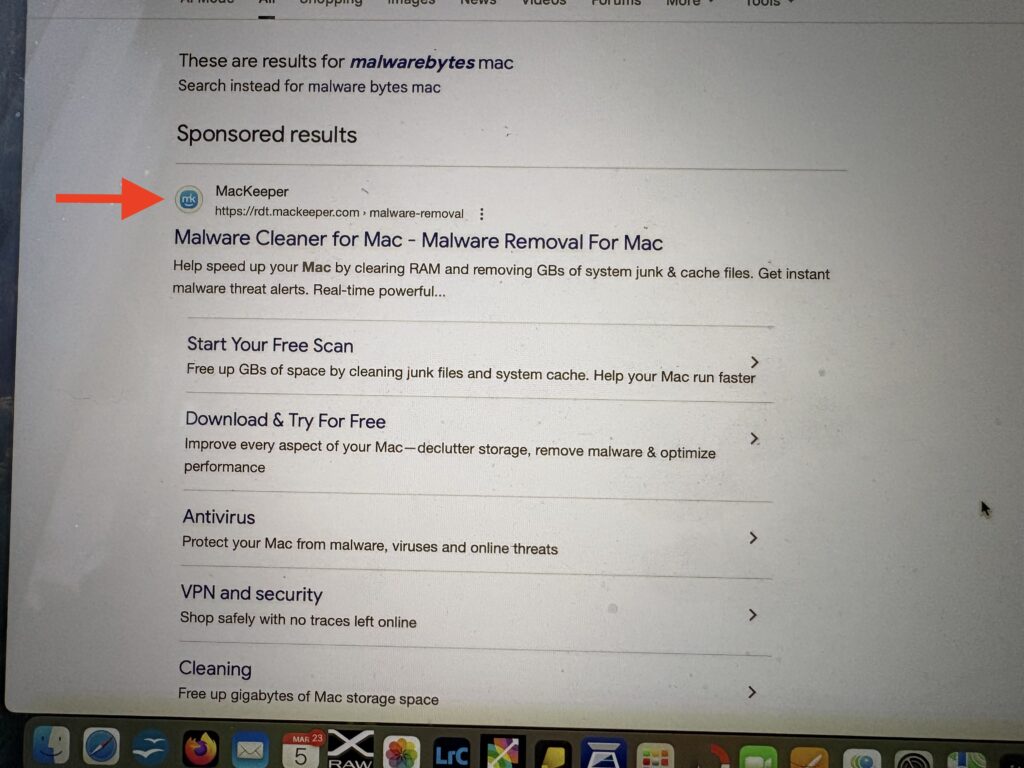
In big, bold, blue letters was malware cleaner for Mac and because my brain would be saying…yeah, thats what I want, that is close enough they are betting on me clicking on it and instead of getting malwarebytes, I’d be delivered MacKeeper… the software equivalent to eye surgery with a whisk and definitely not what I wanted. However because I am crusty and untrusting sole, I didn’t fall into the trap. But I was inspired to write this rant.
So how, I am sure you are asking, did it get there? The answer is the heading “sponsored result,” meaning MacKeeper has paid up bigly to have their product appear at the top of the list, waiting for the unsuspecting to make the mistake of clicking on it instead, thus flooding your Mac with spam.
The other pitfall is trying to get a good deal. We all do it. You need a piece of software. You need something that turns a PDF into a picture of a kitten, or something that allows you to play a video file format that was only used by one Norwegian programmer in 2004.
So, you go to a search engine. You type in “PDF to Kitten Converter Free Mac.”
And there it is! Top of the list. “Trusted Download Site Alpha.com.”
You see a big green button that says “DOWNLOAD NOW.” And because it looks legitimate, and because you are in a rush, you click it.
Would you, if walking down the high street, accept a sandwich from a man wearing a bin bag? No. You would not. Because you have no idea where that sandwich came from, what is inside it, or why this man in a bin bag feels compelled to give it to you.

Yet, online, we are perfectly happy to let random strangers, whose physical location is a complete mystery, insert whatever code they want directly into the very heart of our computer. It is madness.
That download button on “https://www.google.com/search?q=TrustedSiteAlpha.com” isn’t a trusted source. It’s a funnel. And at the other end of that funnel is a vat of sludge.
When you install that kitten converter, you aren’t just installing the kitten converter. You are also installing seven other things you didn’t ask for, which are now, at this very moment, using your processor to mine digital currency, changing your search engine to findarussianbride.com and, most annoyingly, allowing 4,000 new people a day to email you about those generic blue pills.
This isn’t about being “unlucky.” It is about inviting the thieves into your house, making them a cup of tea, and showing them where the silver is kept.
We need a change of mindset. We need to become cynics.
Rule One: The “Trusted” lie. If a website feels the need to call itself “Trusted,” it is almost certainly because they are lying. Truly trusted sources—like the actual developer’s website or the Apple App Store—don’t need to put “TRUST US” in giant neon letters. They just are trusted.
Rule Two: Spend the money. If the choice is between paying $15 for a legitimate app from the Mac App Store, or “getting it for free” from a site that requires you to disable your anti-virus software to “allow the installer to run,” you spend the money. Because $15 is a lot cheaper than having to spend your entire weekend nuking your hard drive, reinstalling the operating system, and changing your banking passwords while sobbing.
There is one, and only one, trusted source. It is the Mac App Store.
Yes, it is slower. Yes, Apple takes a cut of the developer’s money. Yes, the selection is sometimes a bit restrictive.
But—and this is the only “but” that matters—when you click download on the App Store, you know that the sandwich is safe. It was made in a hygienic kitchen, by people in hairnets, and it doesn’t contain anthrax.
My rants about spam;


1 comment
I read your article with a mixture of curiosity and mild bewilderment.
Fortunately, I’ve managed to avoid all of these so-called “scams.” In fact, I’ve recently come into a most welcome inheritance from my long-lost Uncle Cecil in Zambia. All I needed to do was send a modest £250 administration fee, and I’m assured the million-pound sum is already on its way to me as we speak.
Similarly, my bank very thoughtfully alerted me to some suspicious activity on my account, and I was able to safeguard my savings by transferring them to a new “secure” account they provided. First-rate service.
I also heard from a friend who contacted me on a new number to say his phone had been stolen and he urgently needed funds for a train ticket home. £100 well spent, I think – I expect repayment any moment now.
And finally, I’m delighted to report that I shall shortly be receiving a knighthood. Quite unexpected, as I can’t recall doing anything of note, but one doesn’t question these things. The small administrative fee seemed the least I could do.
All in all, I shall continue as I am. One mustn’t become paranoid.